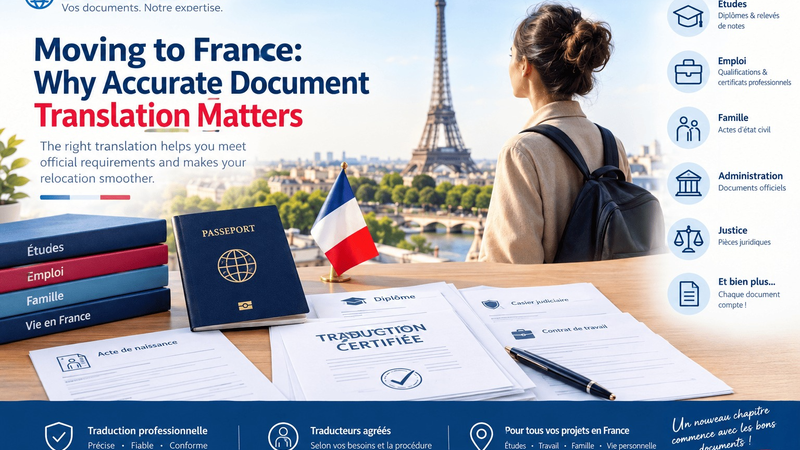
Moving to another country is an exciting experience. Whether the goal is to study, work, start a business, join family members, or build a new life, relocating to France involves a significant amount of preparation. One part of the process that is sometimes overlooked is document translation. Foreign documents may need to be presented to French universities, employers, government offices, courts, banks, or other organizations. When these documents are not available in French, an appropriate translation may be required.
Understanding when and how documents should be translated can make international relocation more organized and help prevent avoidable delays.
Why Do Documents Need to Be Translated?
Official documents contain information that must be understood by the organization receiving them. A birth certificate, diploma, marriage certificate, criminal record certificate, or employment document issued in another language may not be directly usable by a French institution.
Translation allows the information contained in the original document to be understood in French while preserving important details such as names, dates, titles, stamps, and official terminology.
The exact requirements vary depending on the procedure. Some organizations may accept a standard professional translation, while others may specifically require a translation completed by an approved translator.
Common Documents That May Require Translation
People moving to France may encounter many different types of documents during their administrative or professional journey.
Common examples include:
- Birth certificates
- Marriage certificates
- Divorce certificates
- Diplomas and academic transcripts
- Criminal record certificates
- Employment certificates
- Driving licences
- Court documents
- Administrative certificates
- Identity-related documents
- Business and company documents
Students, for example, may need translated diplomas and academic records when applying to educational institutions. Professionals may need translated qualifications, employment documents, or other certificates when looking for work.
Families completing administrative procedures may also be asked to provide translated civil-status documents.
What Is a Sworn Translation?
A sworn translation is different from an ordinary translation prepared for general communication.
For certain official procedures, French authorities may require a translation completed by a translator who is authorized or approved for the relevant purpose. The requirements depend on the procedure and the authority receiving the document.
For this reason, it is important to check the instructions provided by the French administration, university, court, embassy, employer, or other institution before ordering a translation.
Choosing the wrong type of translation can mean having to request another version later.
Translation for Students Moving to France
France attracts students from many countries, and international education often involves substantial documentation.
A student may need to provide:
- A high school diploma
- University diplomas
- Academic transcripts
- Certificates of completion
- Identification documents
- Proof of previous studies
The institution receiving the documents determines what format and language are acceptable.
Students should therefore check the requirements before submitting their application. Preparing translations early can also make the application process more manageable, especially when several documents are involved.
Translation for Work and Professional Life
Moving to France for professional reasons can involve another set of documents.
Employers and professional organizations may request evidence of qualifications, previous employment, professional certifications, or other relevant records.
For regulated professions, documentation can be particularly important because qualifications obtained abroad may need to be examined by the relevant French organization.
Accurate translation helps ensure that the information about a person’s education and professional experience is presented clearly.
Translation for Families and Administrative Procedures
Relocating to France as a family can require numerous civil-status documents.
Depending on the situation, authorities may request documents concerning marriage, birth, divorce, family relationships, or other personal circumstances.
These documents can contain sensitive and highly specific information. Names, dates, places, and official terminology need to be reproduced carefully in the translated version.
This is one reason why professional document translation can be preferable to relying on automated translation tools for official paperwork.
Why Accuracy Matters
Official documents are different from ordinary texts.
A small error in a name, date, qualification, legal term, or administrative expression can create confusion. In some situations, an institution may ask for clarification or a corrected translation.
Professional translation focuses not only on language but also on context, terminology, formatting, and the purpose for which the document will be used.
People preparing documents for use in France can therefore benefit from checking the requirements first and selecting a translation service appropriate for the procedure.
For those looking for professional assistance with documents intended for use in France, Bestraduction provides translation services for administrative, academic, legal, and other official documents.
Translation Is Only One Part of the Process
It is also important to understand that translation and document authentication are not necessarily the same thing.
Depending on the country where the document was issued and the French procedure involved, an authority may require additional formalities, such as an apostille or legalization.
A translation service does not automatically replace these procedures.
Before submitting an important document, applicants should verify all requirements with the organization that will receive it. This can help avoid unnecessary costs and delays.
How to Prepare Documents for Translation
A few practical steps can make the process easier:
1. Identify the purpose
Determine exactly why the document is being translated and who will receive it.
2. Check the official requirements
Ask the receiving authority whether it requires a standard translation, an approved or sworn translation, or additional formalities.
3. Prepare clear copies
Make sure scans or copies of the original documents are complete and readable.
4. Check names and dates
Make sure personal information is correctly represented and consistent across all documents.
5. Allow enough time
Official translation can take time, particularly when several documents are involved.
Making an International Move Easier
Relocating to France involves many decisions, from accommodation and education to employment and administration. Preparing documents correctly can remove one source of unnecessary stress. Whether someone is moving to France to study, work, reunite with family, or pursue a new professional opportunity, understanding document translation requirements early can help make the transition smoother. The key is to identify the requirements before starting the translation process. With the right documents, the appropriate translation, and proper preparation, international administrative procedures can become much easier to manage.