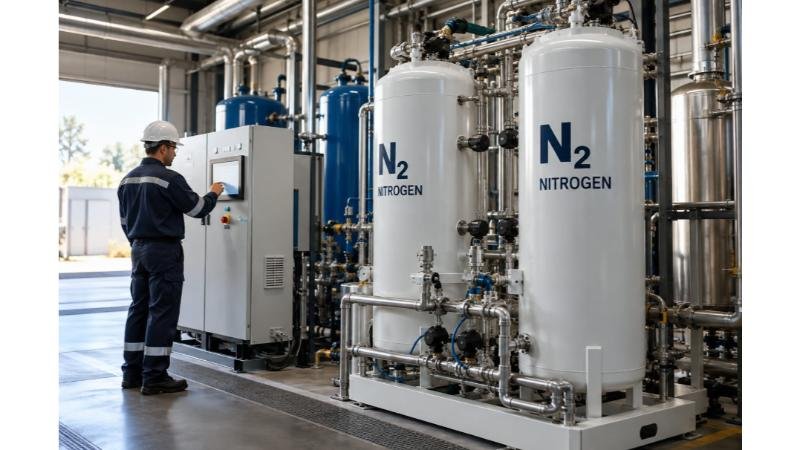
Nitrogen plays an important role in modern industry. From food packaging and pharmaceuticals to metal treatment, electronics, chemicals, and manufacturing, many processes depend on a stable supply of nitrogen gas. Its ability to create an inert atmosphere makes it particularly useful where oxygen needs to be reduced or controlled. However, obtaining nitrogen consistently, economically, and at the right purity can present several challenges for industrial companies.
As production requirements increase, businesses often need to reconsider how they source and manage their nitrogen supply. Traditional delivery methods can work well for certain applications, but companies with continuous or high-volume requirements may benefit from producing nitrogen directly at their facilities.
The Main Challenges of Industrial Nitrogen Supply
One of the biggest challenges is logistics. Businesses that purchase nitrogen from external suppliers depend on scheduled deliveries. Cylinders, bundles, or bulk storage systems must be transported to the facility regularly. Any unexpected delivery delay can potentially interrupt production, particularly when nitrogen is essential to an ongoing manufacturing process.
Storage requirements can create another challenge. Depending on the method used, companies may need dedicated areas for cylinders or larger nitrogen storage equipment. These areas require appropriate safety procedures, monitoring, and handling. Maintaining stored gas also means companies must carefully plan their consumption and reorder supplies before existing reserves become insufficient.
Cost is another important factor. The price paid for externally supplied nitrogen can include more than the gas itself. Transportation, cylinder rental, storage, handling, and delivery charges may all contribute to the overall expense. For businesses with substantial nitrogen consumption, these recurring costs can become increasingly significant over time.
Purity requirements can also vary considerably between industries. A food-processing facility may have different requirements from an electronics manufacturer or pharmaceutical company. Maintaining a consistent level of nitrogen purity is therefore essential for applications where gas quality directly affects the production process.
How Does a Nitrogen Generator Work?
A nitrogen generator provides an alternative method by producing nitrogen directly from compressed atmospheric air. Since air contains approximately 78% nitrogen, it can be processed and separated to obtain nitrogen suitable for industrial applications.
The process starts with compressed air entering a treatment system. Filters and other components help remove moisture, oil, particles, and other contaminants that could interfere with the separation process. Once the air has been properly treated, it enters the separation stage.
The separation technology removes oxygen and other unwanted components while allowing nitrogen to pass through. The resulting nitrogen can then be supplied directly to the production process or stored for later use, depending on the facility’s requirements.
There are several nitrogen-generation technologies available, but Pressure Swing Adsorption, commonly known as PSA, is widely used for industrial applications.
Understanding PSA Nitrogen Generation
PSA nitrogen generators use a material called carbon molecular sieve to separate nitrogen from compressed air. This material has the ability to preferentially adsorb oxygen and other gases while allowing nitrogen molecules to pass through.
The process takes place in specialized adsorption vessels. During the adsorption stage, compressed air enters one vessel and the molecular sieve captures oxygen and other unwanted gases. Nitrogen passes through and becomes the product gas.
Once the adsorbent material approaches saturation, the system reduces the pressure inside the vessel. This releases the captured gases and regenerates the molecular sieve. A second vessel can then perform the adsorption stage while the first vessel is regenerated.
By alternating these cycles, PSA technology can continuously produce nitrogen without requiring a conventional external gas delivery schedule.
One of the main benefits of PSA technology is its adaptability. Systems can be designed around factors such as nitrogen purity, flow rate, operating pressure, and the specific requirements of the application. This makes PSA generation suitable for many industrial environments.
What Novair Has to Offer
Novair develops industrial gas-generation solutions for companies that need reliable and controlled access to nitrogen. Its nitrogen-generation technology is designed to help businesses move toward on-site production rather than relying entirely on externally delivered gas.
For companies with regular nitrogen consumption, generating gas at the point of use can simplify supply management. Instead of arranging frequent deliveries, the facility can produce nitrogen according to its operational demand, provided the system is correctly sized and supported by an appropriate compressed-air supply.
Novair’s solutions can be considered by businesses across different industries where nitrogen purity, availability, and operational continuity are important. Selecting the right equipment requires an assessment of factors such as consumption levels, required purity, pressure, available infrastructure, and the nature of the application.
Moving Toward Greater Control
Industrial nitrogen supply involves more than simply obtaining a required volume of gas. Companies must consider delivery schedules, storage, operating expenses, purity, safety, and the consequences of an unexpected interruption.
On-site nitrogen generation offers businesses another way to approach these challenges. With technologies such as PSA, nitrogen can be produced from compressed air at the facility and supplied according to production requirements.
For organizations seeking greater control over their industrial gas supply, understanding the available generation technologies is an important first step. A properly selected and maintained nitrogen-generation system can provide a practical approach to managing long-term nitrogen requirements while reducing dependence on traditional delivery-based supply models.